
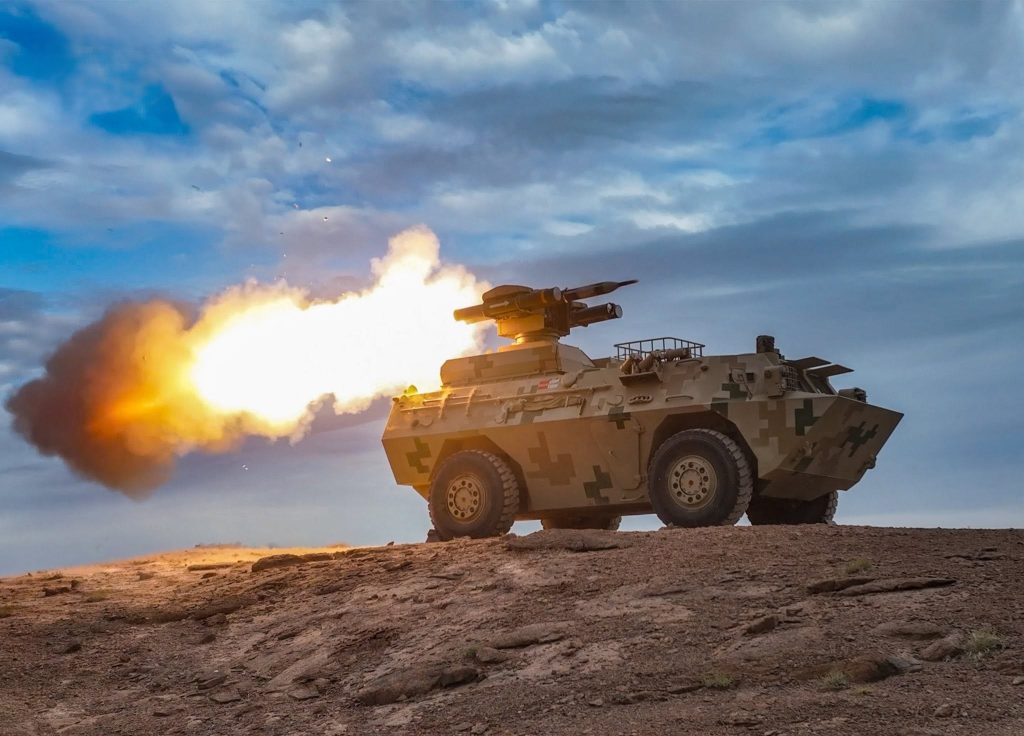
by Brett Macdonald/Images:China Military Bugle & Chinese People’s Liberation Army (PLA)
For many decades China lagged far behind the West in technological terms. Their defence inventory primarily consisted of older Soviet-supplied equipment, some of which they manufactured locally under license with their own designations. Western defence planners were confident that the technological gap was vast and that Chinese numbers alone would invariably force their defence posture into a continued one of attrition.
During the Cold War the same was true (albeit to a much smaller extent) of the USSR, where Western defence strategists assumed that numbers alone would continue to constitute the backbone of Soviet defence doctrine. Every so often however, the Soviet Union would field new equipment that would come as a technological surprise to Western analysts. The first flights of the Su-27 and Mig-29 prototypes in 1977 served as such a surprise- and cause for concern. Their manufacturing base had always built vast numbers of equipment, but if the technological gap had managed to be closed, this would’ve meant that they could henceforth produce large numbers of near-peer equivalents, making their numerical advantage a deep source of concern for any potential adversary.
China’s economic rise in the civilian sphere has been meteoric over the past three decades. Their high-speed railway infrastructure exceeds 50,000km which is more than the rest of the world combined, at around 86% of the global total. Considering that they only started building high-speed rail in earnest in 2008 makes this feat even more remarkable. Apart from the sheer scale and short timeframe, another important factor is the cost: China manages to build high-speed rail for $19 million per kilometre, while that same distance costs an average of $32 million in Western Europe and $56 million in US states like California. This trend extends to other areas like shipbuilding too, where China’s orderbook consists of 60% of all ships being built globally. By contrast, the USA is currently building less than 1% of global commercial ship output.
While it may be argued that these are civil projects and don’t directly translate into defence projects, the numbers are still very telling. At present China produces about 25 major warships per year, while by comparison, the US produces 5 or 6 per year. The US Navy still leads in terms of total tonnage, but this gap is shrinking rapidly and the People’s Liberation Army Navy (PLAN) already leads by hull count at 370 vessels opposed to 290 US naval vessels, projecting on a 50% numerical advantage by 2030. The same trend is visible in aircraft as China produces 300 (and up to 400 by some estimates) advanced fighter jets per year. Two-thirds of this figure constitute 4th generation units like J-10’s & J-16’s; and one-third are 5th generation units like the J-20 & J-31. By comparison the US produces slightly more 5th generation fighters at their various F-35 production lines, totalling around 156 units for their own- and allied- forces; and 35 to 50 4th generation units per year. It should be noted that the F-35 is a shared program with components being manufactured across a wide spread of participating countries.
Drones
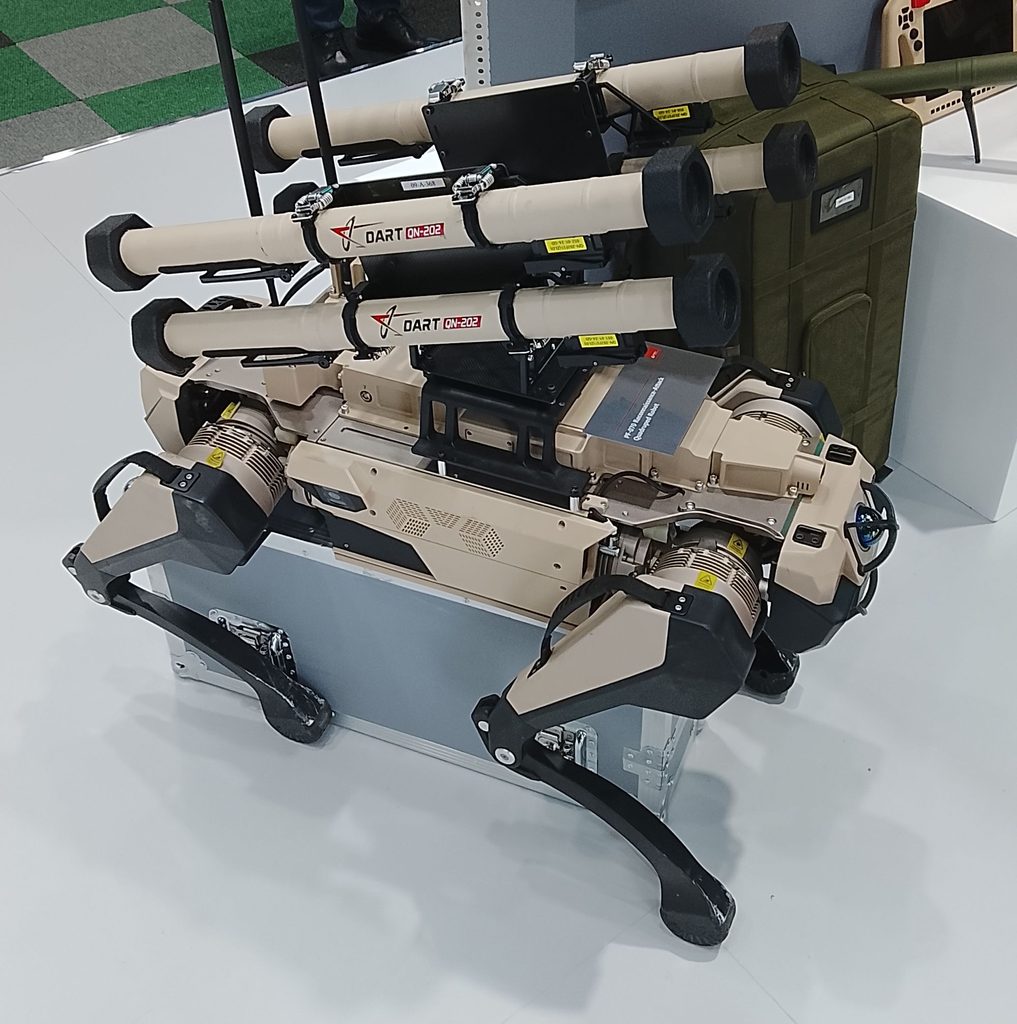
At the recent African Aerospace and Defence (AAD) expo held at Airforce Base Waterkloof in October 2026, the Chinese pavilion was well represented. A ‘dog-drone’ greeted many visitors in the hallway drawing attention, which are referred to as “robot wolves” models Sharp Claw 1 & 2 and are designed to operate on the ground alongside human soldiers and chase down adversaries. They’re equipped with several sensors and operable with LiDAR for 3D mapping, target acquisition & recognition. These four-legged troop companions can be armed with a choice of assault rifles, shotguns grenade launchers and even rocket launchers. They are protected by thermal & fire-resistant armour withstanding up to 500 degrees Celsius as they’re designed to go into hostile situations ahead of their human counterparts.
Earlier this year a Chinese drone show made the Guiness World Records for the largest number of autonomous drones sent into the night sky to perform a light display, from a single computer. Guangdong E-Hang Egret Media Technology launched 22,600 individual multi-rotor drones (of which 11,580 took off at a 99.83% success rate) and conducted an intricate light display. While this record was for the largest aerial drone display from one single computer, the absolute record also belongs to China who conducted another light show in 2024 involving 33,615 individual copter drones. Considering the precision involved in achieving the navigational spacing to conduct moving light shows involving complex shapes and pictures across thousands of independent flying objects, the military applications are sobering- especially when it comes to involving swarming drones in kamikaze fashion. Using just one drone pilot with advanced AI for autonomous swarm technology, defences can easily be overwhelmed with inexpensive one-way drones, while their sophistication can be used to tactically evade known defensive system doctrines, ensuring successful penetration and hits. They have even been programmed to mimic natural environmental factors like flocks of birds. Their algorithms ensure that they complete their mission even if the connection to satellites gets broken or communication with the human command centre is lost.
The Jiutian or “Nine Heavens” is a large jet-powered Unmanned Aerial Vehicle (UAV) that first flew in late 2025 and acts as a mothership, with a payload of six tons and is able to deploy 100 smaller drones through a ‘hive’ compartment in mid-flight. With an endurance of 12 hours and a ferry range of 7,000km, it can perform as a standoff weapon to saturate enemy defences and command centres by unleashing drones and air-to-air or air-to-ground missiles. Since its payload configuration is modular, the bay can also swap weapons with heavy cargo loads for general unmanned air transport.
Russia’s “Loyal Wingman” project which pairs the Sukhoi Su-57 with S-70 Okhotnik-B drones, now has a Chinese counterpart. Designed to fly ahead, the Sharp Sword is responsible for clearing the skies for manned fighter jets by destroying aerial decoys. It’s constructed in a stealth design and able to operate off the decks of amphibious assault vessels. When gathering targeting data for anti-ship ballistic missiles, the extra long-range Soaring Dragon performs this mission as a bomber launch drone. To mirror the US’ RQ-80, China have launched a series of drones from the CH-4 & CH-5 to the stealthy flying wing designated CH-7. For export, the Wing Loong WZ-10 high-altitude semi-stealthy reconnaissance drone has been exported to Saudi Arabia. Collaboration with Iran has been evident in the Wing Loong 300D which was derived from the Iranian Shahed 136 low-cost one-way kamikaze or loitering drone, but at even further reduced cost. According to China North Industries Corporation (NORINCO) the state-owned conglomerate, they have managed to bring the unit price down by 50% below the Iranian production cost- at only $10,000 per unit.
Naval Assets
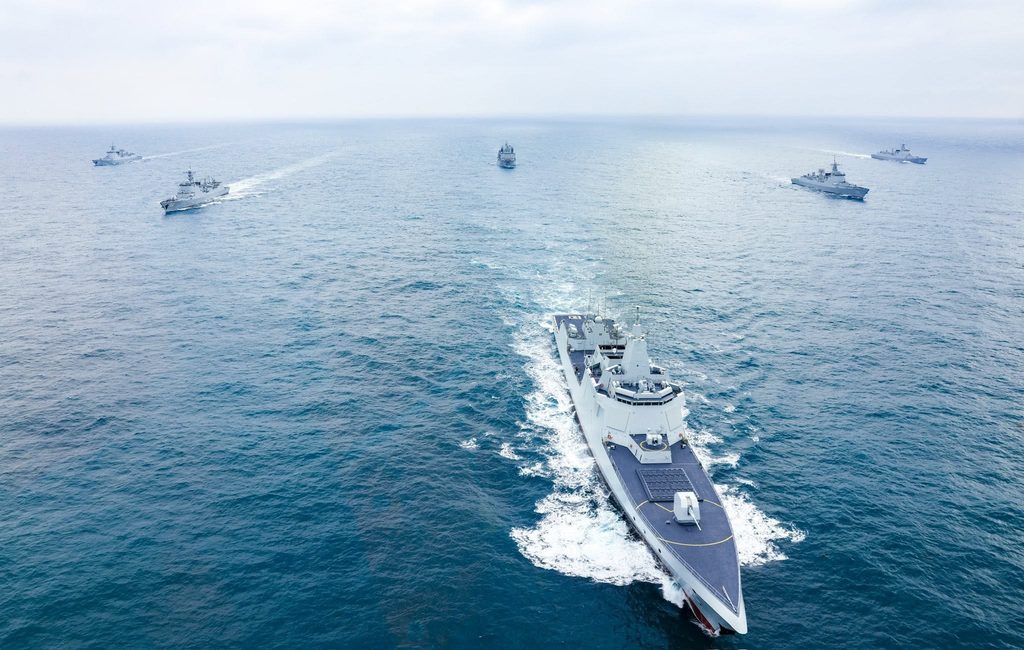
In addition to the new nuclear-powered Type-004 aircraft carrier coming into service and projected to number nine units in service by 2035, ten new Type-55 destroyers have been added to China’s blue water naval fleet, with another 6 units to follow. These large destroyers will complement their 35 modern (but smaller) Type-52D destroyers, along with 20 destroyers of other classes, frigates exceeding 50 in number, landing craft, resupply ships on a large scale and 76 ferries designed to operate in conjunction with water bridge barges- a new design that sees them join together to provide a bridge for landing their forces from the mothership further out in deeper water, to dry land.
In the underwater arena, satellite imagery this year has shown a massive new class of submarine that does away with the conventional conning tower/sail. For numerical context, in the last 5 years alone China has launched up to 20 units in eight different classes of submarines. Alongside manned submarines are large Unmanned Underwater Vehicles (UUV’s) measuring 45m in length, together with smaller dedicated reconnaissance variants that can operate autonomously in endurance missions, acting as torpedoes and even work together in swarms- much like their aerial counterparts.
Nuclear Deterrent
As recently as 2020, China had an estimated nuclear arsenal of 300 warheads, but in just the last six years this figure is believed to have doubled to 620 units. Not just the warheads themselves, but their delivery systems have seen consistent ongoing development. These include Beijing’s mobile land platforms which can launch missiles to their targets 12,000km away, as well as airborne platforms. In the intermediate range China’s Dongfeng DF-26 missiles can carry nuclear or conventional warheads up to 5,000km. Hypersonic missiles and dedicated anti-ship missiles have also been prioritised. Pentagon sources predict that China’s nuclear arsenal will catch up with that of Russia and the United States by the mid 2030’s.
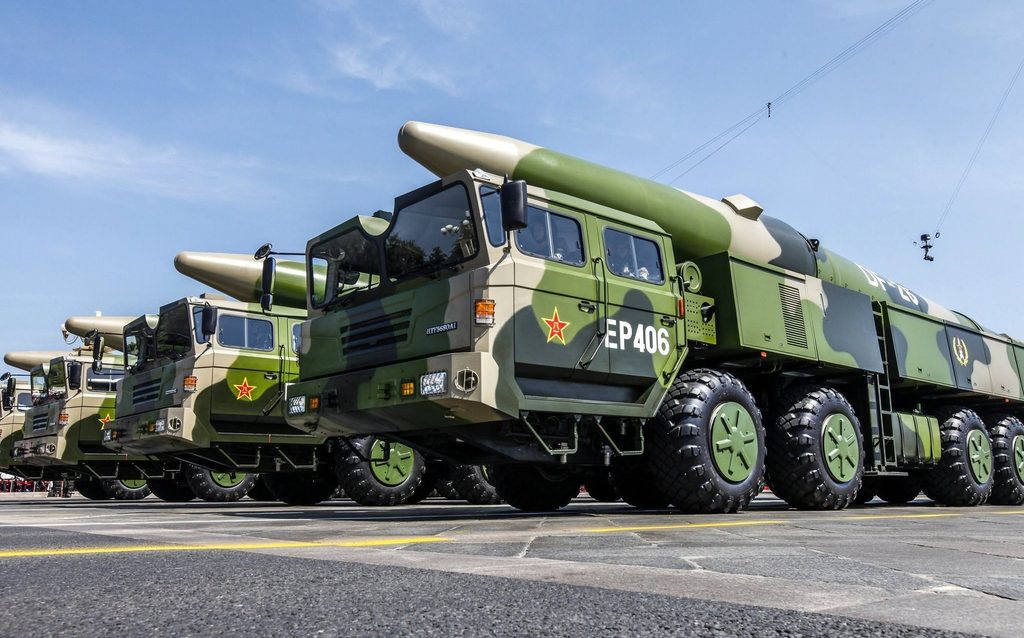
While Western defence analysts estimate China to possess between 130 & 140 missile production sites based on satellite surveillance, how many underground manufacturing and storage facilities exist are unknown. What is known however, is that China is currently undergoing its most rapid and comprehensive expansion in history, from a lean minimum deterrence posture, to a modern, diversified nuclear triad.
While their previous traditional delivery vehicles were predominantly land based, the Jin-Class (Type 094) nuclear ballistic submarines are now armed with longer range JL-3 Submarine-Launched Ballistic Missiles (SLBMs) that allow for launches within their protected home waters, due to their extended range.
Land Assets
The Chinese military’s personnel strength is the largest in the world at 2 035,000 active members, plus 510,000 reservists and 3 625,000 in paramilitary roles, like the police who can be called up in a crisis situation.
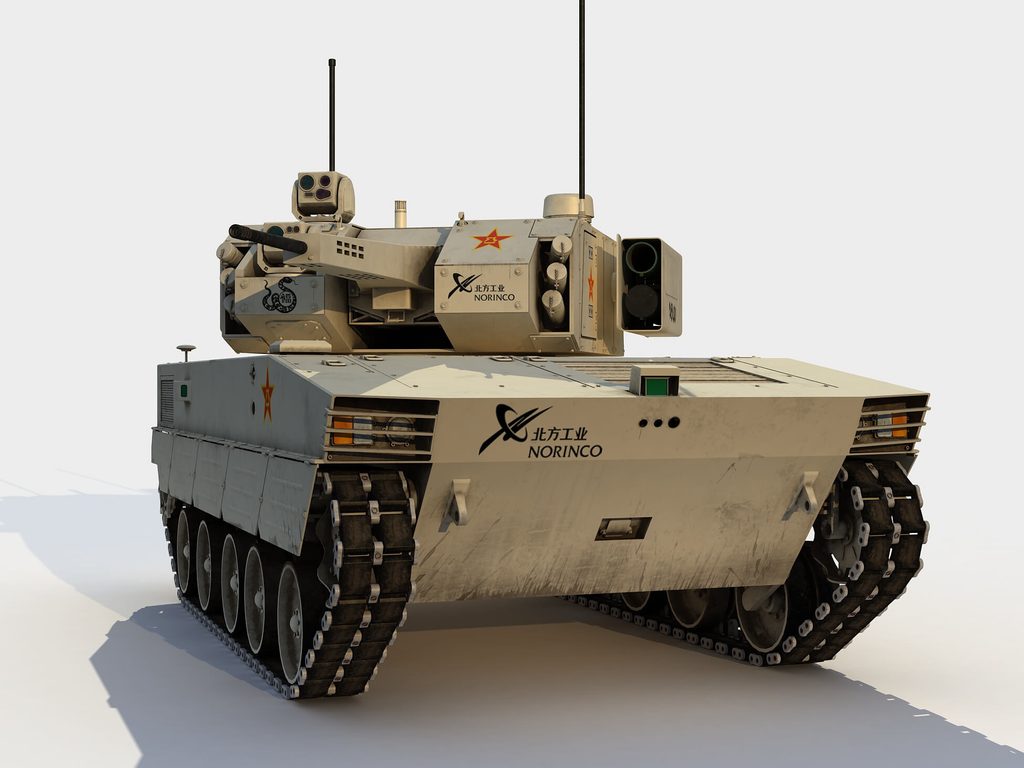
To support these personnel, NORINCO developed a robotic tank, called the VU-T10 that’s a 12-ton heavy armoured ground vehicle. It’s designed for pathfinding, scouting, minefield detonation, bunker clearing, fire support, eradication of light-armour targets and destruction of low-flying drones. Operating within NORINCO’s AI-driven Manned/Unmanned- Teaming (MUM-T) architecture, it can operate via remote-control or autonomously- and without GPS should radio links be jammed by an enemy. To further counter the threat posed by drones to friendly forces, Overhead Weapon Systems (OWS) are ground-based high energy laser-directed weapons to target the small slow-flying aerial threats posed by small drones and even incoming mortar fire.
This provides a far cheaper solution than firing expensive surface-to-air missiles at all airborne threats, a benefit that’s become unavoidably apparent in all the current major conflict zones.
For light infantry and special forces, the Lijian III is a state-of-the-art manheld anti-drone laser weapon which can be carried in a backpack, weighing 25kg. Using AI for rapid target identification and acquisition, it can destroy an enemy drone’s electronics within 4 seconds of painting it and then be ready to disable a new target within 5 seconds afterwards.
The Atlas is a land vehicle which singularly launches 48 fixed-wing drones through an AI-powered management system at a rate of one drone every three seconds. Thereafter, it allows as many as 96 drones in the air to synchronise for precision strikes and reconnaissance, depending on the mission parameters.
Air Assets
When the J-20 first flew from the Chengdu Wenjiang Airport in 2011, observers were unsure if China’s homegrown 5th generation jet was a pure fighter, or a type of interceptor- possibly a dedicated anti-ship platform due to its large size? It was criticised for borrowing Russia’s Saturn AL-31F turbofan engines for its development and entry into active service. It subsequently transitioned to the domestic WS-10C engine and now after 15 years has received domestic clean-sheet WS-15 low-bypass afterburning turbofan engines, incorporating supercruise and Trust Vector Control (TVC). Until recently only a handful of countries processed the capability of developing and constructing their own jet engines and now China is part of that elite club too. The J-20 is currently being produced in numbers of 100 to 120 per annum.
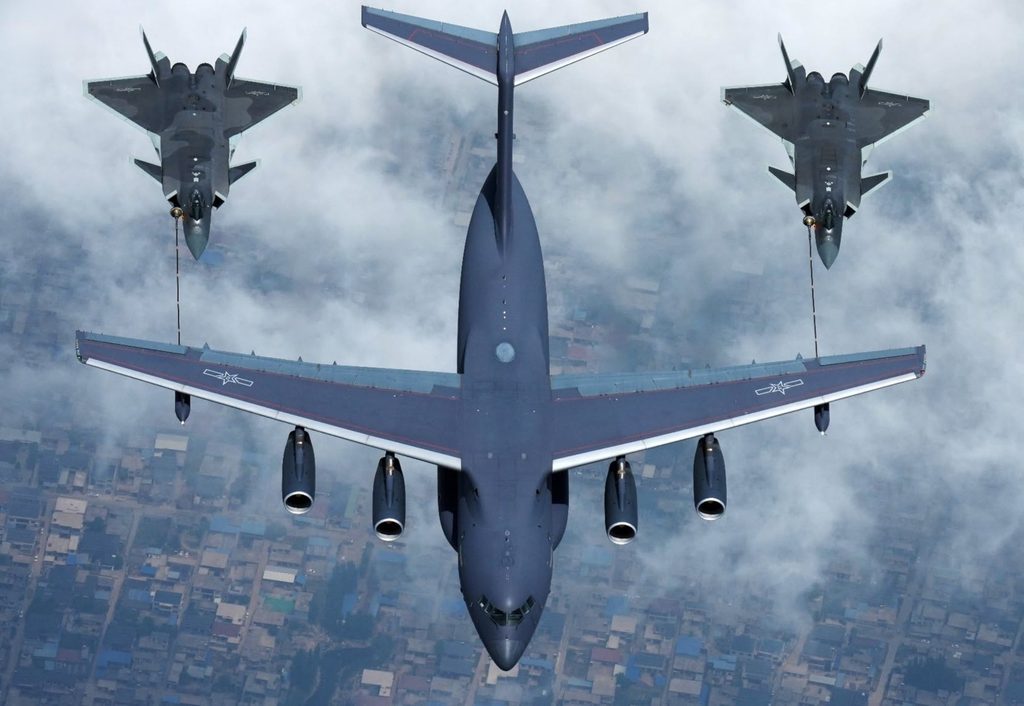
Just as no country in the world has completely phased out their 4th generation fighters to make way for the 5th generation, seeing the US still operating large numbers of F-15’s, F-16’s & F-18’s and Russia still operating many Su-27/30/33/35’s & Mig-29 upgrades, China is also still producing 100 J-16 fighters and up to 50 J-10C’s annually. As in the case of the US and Russia relying on legacy fighters to provide the numerical backbone of their fighter squadrons, these 4th generation fighters are buying time while China develops their 5th generation carrier variant, the J-35. The J-35 can be described as a direct competitor to the F-35C which are restocking Western carrier inventories at a moderate pace. Considering the scale at which China is upping their fleet of aircraft carriers, it stands to reason that the J-35 designed for it, will be ramped up in significant numbers as well.
The most anticipated fighter program emerging from China is their 6th generation J-36. While there’s debate about whether it meets all the criteria to be called a 6th generation jet, the exact definitions that constitute the 6th generation are subjective at best. It was first spotted flying over the city of Chengdu in 2024, displaying a tailless design comparable to artist renditions made public of the US’ F-47 6th generation program. There are 5 known units currently flying in its development program, confirmed by the Chinese military. Also spotted was another tailless design nicknamed “J-50” in the West based on satellite images (in the absence of an official designation) that uses an advanced lambda wing design.
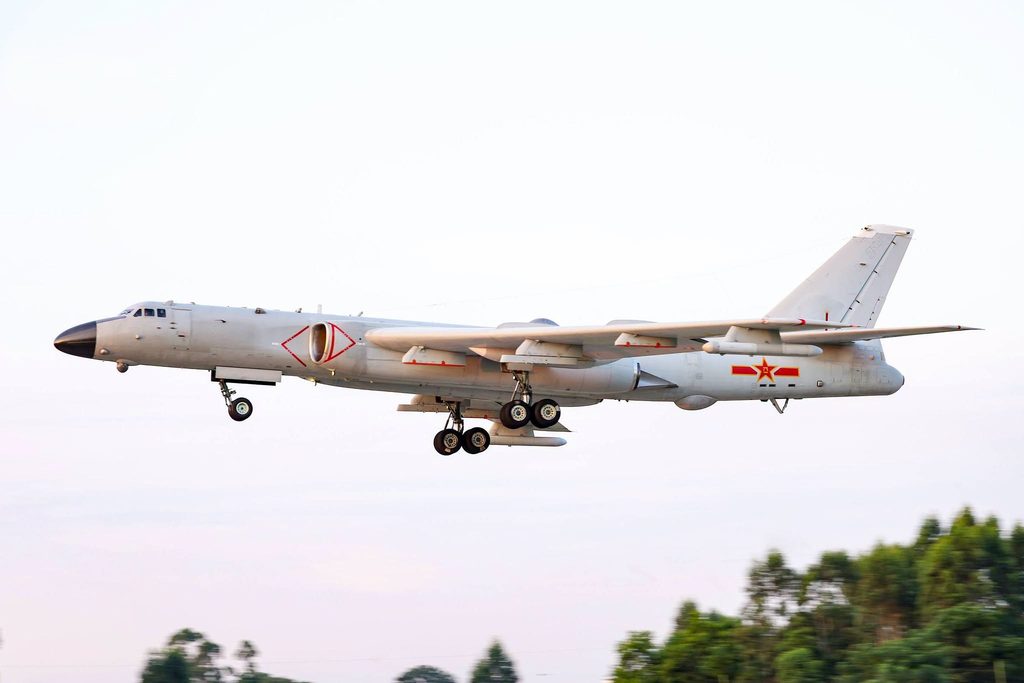
As the much-anticipated stealth bomber, the H-20, continues on its development cycle, China has been overhauling their existing long-range bomber fleet to keep them relevant, turning some into missile platforms e.g.: upgrading the legacy Xi’an H-6 family to the H-6N, where the centreline has been recessed to give the People’s Liberation Army Air Force’s (PLAAF) existing bomber fleet an air-launched ballistic missile (ALBM) capability, with their JL-1 missiles.
The same is true for their battle & control aircraft, air-to-air refuel aircraft and in the logistical sphere their strategic & tactical airlift assets have undergone a major metamorphosis, led by the Xi’an Y-20 family of domestically produced heavy-lifters.
Attrition or Technological Superiority
Over the last three decades many Western companies moved their production to China to save on production costs and whilst doing so, invariably exported their skills and know-how as well. While China can no-longer simply be described as a ‘cheap manufacturing hub’ but rather as an affordable high-tech manufacturing destination, they certainly still retain the ability to produce cutting-edge equipment at scale, for a fraction of what it would cost in any Western production facilities.
China has successfully transitioned both her commercial economy and defence industry from a purely mass-production centre suited only to attritional warfare, into a sophisticated trend-leader who’s still able to produce in staggering quantities. While their primary focus remains on commercial production and infrastructure development, should the situation ever switch towards a true wartime economy, they’ll undoubtedly pose a challenge in both volume and sophistication that’s never been seen in the history of warfare- and at a price no nation can match.