
by Brett Macdonald/Images:CSIR
The Council for Scientific and Industrial Research (CSIR) was co-founded by Field Marshal Jan Smuts and Sir Basil Schonland on 5 October 1945 to conduct directed research for advancing science and industry, in a bid to support post-war industrial growth in the country after World War Two. Headquartered on the “Scientia” campus in Pretoria, it has remained an integral institution in the local scientific community ever since developing South Africa’s very first radar back in 1945. This was followed by numerous milestones like microwave electronic distance measurement equipment in 1954 which revolutionised global land surveying; notable contributions in lithium-ion battery technology in the 1980s; and a long list of military innovations ever since.
As a mainstay of defence and aeronautic contributions, the CSIR was yet-again a prominent feature of the latest instalment of the African Aerospace & Defence (AAD) expo held at Airforce base Waterkloof in September 2026. 3D Printing has long been part of the CSIR DNA, as well as support to aeronautics by providing wind tunnels since the 1980’s. These contributions cover a broad span of defence-related technologies from space, to drones, to the new camouflage uniforms for the South African National Defence Force (SANDF). A sampling of the new products clearly reflects a balance between looking to the future whilst still keeping their feet in grounded reality.
MOBS
Dr Sunveer Matadin, the research centre head for Robotics and Future Production showcased a modular system known as the MOBS, which is versatile enough to be used in land applications including Mine Clearing; Patrolling; Surveillance; Search and Rescue, as well as in space applications where these systems reduce the need for manned astronaut hours for ongoing missions. MOBS presents a modular multiple-use system that can be used for a wide range of tasks on land, air and in space.

Drones
Drones are prominently featured, including relatively inexpensive one-use targeting drones under Project SWIFT. This makes sense in the modern environment where the cost factor in drones becomes of paramount importance. A recent example of how cost-effective drones can serve as a major force-multiplier has been the current conflict in the Middle East, where inexpensive drones have proven to overwhelm more expensive systems with volumes, making the cost analysis a race to the bottom. In an ironic twist, effective defence is no-longer measured just in the sophistication alone, but in how simply and cheaply these systems can be brought to bear.
K-Line Camera
Another innovative system with both air (via drone) and space (via satellite) applications is the K-line camera, which is used for fire detection to prevent veld fires and to guide the helicopters carrying water during emergencies. It operates by detecting traces of Potassium emitted from burning vegetation. It consists of dual cameras each fitted with a different filter- but that work in conjunction over a 10 degree overlap- to detect either Potassium or serve as the “reference channel” and then provides a live stream to a ground station to be actioned. This whole eye-in-the-sky only weighs 1.4kg making it ideal for fitting onto small drones and satellites.

TYTO: Experimental Multispectral Long-Range Surveillance System
The TYTO is a lightweight long-range surveillance system designed to be able to be operated by one person, at only 20kg. By combining Near-Infrared (NR), visual and Long-Wave Infrared (LRIR) imaging technologies with sensor integration, it provides real-time observation across several operational environments. It can also be integrated with a radar and mounted on a pan-tilt unit (PTU) providing enhanced tracking, target detection and designation capabilities.
Meerkat
The CSIR showcased their Persistent Wide Area Surveillance System known as the “Meerkat” which is aimed at anti-poaching operations, since the system is tailored to detecting threats in the bush. In broader military environments these can also be used for patrols and to identify and detect enemy who are hidden. This is typically a ground-based radar and integrated sensor system with 20,000 ha coverage to detect and identify intruders in an area of interest, to provide reaction forces accurate real-time information for interception.
Passive Radar Technology for Air Traffic Situational Awareness
Over the past eight years the CSIR has been undertaking research and development on passive radar applications. Users include airports and armed force bases assigned with the responsibility of securing the country’s airspace against intruding air targets. These use cost-effective third-party illuminators like Frequency Modulation (FM) public broadcast antennae to detect an object of interest. They typically have a 360-degree detention range of up to 80km for a medium sized fighter jet and 50km for a Class 2 Unmanned Aerial Vehicle (UAV). Several countries are investigating this field as a low-cost way to fill the gaps between active radar networks. Although a fairly new endeavour, the CSIR envisages this work to have a strong marketplace in developing countries, particularly in Africa.
Inundu Multi-Purpose Fast Jet Electronics Pod
A modular multi-purpose pod has been developed that can be fitted to a variety of airborne platforms- including fast jets. It consists of 150 litres for custom electronics payloads; a windowed nose cone for optical payloads; cooling and heating with automated temperature control to protect the electronics from condensation. It was designed to be similar in size and mass to the BL-755 and is therefore compatible with a wide range of aerial platforms including the BAE Hawk, F-16, Tornado, Mirage F1, F-4 Phantom and Alpha Jet and even business jets with the standard lug interface. The standard weight of the pod is 260kg with a performance envelope of up to 500 KCAS, Mach 0.95, 35,000 ft and from -3g to 6g. The pod is aerodynamically stable and can be jettisoned.

New SANDF Uniforms
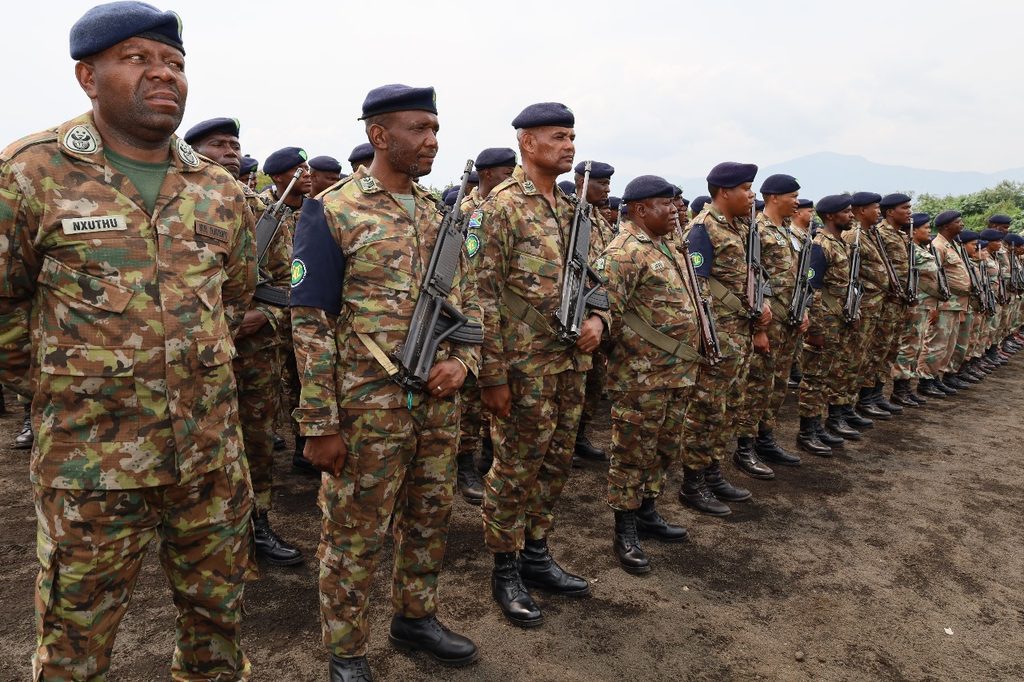
The current SANDF uniforms were introduced in 1994 and the new ones developed in conjunction with the CSIR come with numerous improvements. Extensive testing was conducted for the camouflage against a wide variety of terrains. The pattern ultimately selected has been patented. While the old uniforms were identical for male and female soldiers, the new ones are cut to be gender-specific, allowing for a better fit. In the places where ranks and proficiency badges were previously sewn on, they now have Velcro sections to make this process simpler across all the uniforms at times of promotion or qualification. The material texture is more comfortable they’re also fitted with more pockets. To allow for temperature changes, they have removeable inner-linings (similar to the “slangvels” in Parabat jump-jackets). The CSIR has also worked on new male and female boots, cut to be tailored directly towards either men or women foot shapes. They are now lighter and more durable too. There are also boots developed that are similar to the “waxies” used by special forces, which are more comfortable.
Overall, the CSIR’s relationship with the SANDF is clearly reflected in all the products, since these holistic solutions can only be achieved in close conjunction to meet all the diverging parameters.